Canadian Bresse


The Ultimate Farm Bird
The Gauloise (Bresse) is a dual purpose breed known world wide as the blue footed chicken from France and is rumored to provide fat marbled meat and flavor not comparable to any other dual purpose breed available. We can say with our proven lines that the Bresse is a fast growing breed which outgrows any other breed we have and comes pretty close to outlaying most of our other breeds on the homestead. The breed can be traced back as far as 500 years ago in the Bresse region of France where this breed has long been treasured and protected for its rich fatty meat quality and great laying capabilities.
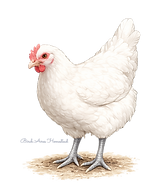
White Bresse are easy to identify for the crisp white plumage and Slate coloured legs and feet.
Chicks however hatch with yellow legs and feet which begin to turn blue around 2-3 weeks old, Some a little earlier depending on the line. The colour will gradually get darker as the weeks go by and will be set by the time they are 8 weeks old.
Age to Process
14 - 16 Wks 3.5 - 4lbs Dressed (BBQ and Fry)
17 - 18 Wks 4 - 4.5lbs Dressed (Soup and Roasting)
18 - 20 Wks 5lbs Dressed (Slow roast/pressure canning)
What we call our P1 line is large enough by 14 weeks to process for an average of 3.5 - 4lbs dressed and work well for parting and frying or barbecuing. We find that at 16 weeks for processing the breast meat is tender and can be fried or barbecued but the legs and thighs need to be cooked a little longer and a little slower to reach tender. We typically use the breast at this age for cutlets and pasta dishes and the thighs and legs for dishes like curry and jerk which require a longer stewing time.
We process hens around 21 weeks for the freezer and a dressed hen at this age will average 4lbs and is best for slow roasting, soup/stew or pressure canning to have that ready to eat sweet and tender quick chicken meal on your pantry shelf.
We often plan out a "special finish" for the cockerels we plan on processing. By specially finishing our Bresse cockerels we find it improves the fat quality (more fat) and we find it is more evenly distributed over the entire bird in larger amounts making for a very juicy, tender, succulent meal. We special finish anywhere from 7 - 14 days depending on what we are doing with our finished birds and how many we are finishing. Our finishing feed consists of Whole powdered Milk, Corn, barley and Red wheat berries.
We follow a strict breeding program for our dual purpose breeds as they excel in growth compared to our layers and more often than not are a part of our homesteads and farms for the purpose of their egg laying capabilities and an antibiotic, hormone free pasture raised meal on the table.


A portion of our program requires a hands on weekly check in from week one up to week 16 where we physically assess our birds and track their weight gain and overall proportions as they grow. By processing age we are able to cull for slower growth and smaller size and selectively breed for quicker growth rate better body type, larger size (to name a few traits) on both pullets and cockerels. In our selection process we are also assessing for overall proportions to meet the proposed American "draft standard". Some of the things we select for are white ear lobes, straight toes, dark slate legs and feet, long backs a wide body (Heart girth) a deep chest and overall health all while not losing the "Balance" of the bird. We also find that Bresse benefit from control feeding, especially hens as they can get too much of a build up of fat which directly affects rate of lay.
Eggs and Point of Lay
19 Weeks point of lay (on average)
250-280 large eggs annually (great winter layers)
Our hens lay a cream sometimes pink toned egg to a light tan egg depending on the line. Our hens are very good layers as we do push to breed our largest and best layers forward.
Our one line of white Bresse goes through a double yolk phase when they begin to lay around 19 weeks old and will give large double yolked eggs during their early laying cycle. We typically see consistent single yolked eggs once they reach 8 months of age.
Keeping Bresse on the Stead
Canadian Bresse are curious and friendly as chicks and are easy to work with and handle as juveniles and adults. The roosters are even tempered and protective of their hens but respectful of their handlers.
Hens are both kid and toddler friendly, breeding age cockerels and roosters are not good with toddlers or kids in our experience. Something to keep in mind if you have young ones helping.
Bresse free range well and enjoy being out on pasture.
Our Feed Program (All Breeds)
We feed a non-GMO, non-medicated ration throughout every stage of our poultry program from hatch day through to processing or maturity. Our chicks are started on a 21% protein crumble from day one until approximately four weeks of age. At that point, they transition to a 17.5% grower crumble, which is fed until processing for birds intended for the freezer. Pullets destined for our breeding and breakfast flock are gradually transitioned to an 18% layer pellet approximately one week before the onset of lay. Free-choice granite grit and oyster shell are provided to support proper digestion and shell quality.
Our decision to feed non-medicated rations is rooted in our commitment to developing naturally robust and resilient flocks. Through thoughtful management practices, we aim to support the development of natural immunity to the environmental strains of coccidia and bacteria commonly encountered in our region. Rather than relying on routine medications, supplements, or antibiotics, our focus is on raising healthy poultry through sound husbandry, nutrition, and flock management.
As young chicks, this includes carefully supervised outdoor access, maintaining clean and dry brooder environments, and minimizing unnecessary stress. These practices have served our flock well season after season and continue to be an important part of our stewardship approach.
Every farm operates under different conditions and management goals. We encourage all poultry keepers to conduct their own research and make informed decisions that best suit their flock, environment, and production objectives.
Bresse Genetics (Dominant White)
The White Gauloise (Bresse) is based on Dominant White for pure white plumage with a chance of yellowing in adult males. We select for white feathering with the least amount of yellowing. Recessive White carriers in a Dominant White line will hatch with yellow chick down and show blue or black spots throughout the down and can mature with a "muddy" appearance. Recessive white carriers are also slower to grow. We do not recommend using recessive carriers over the dominant white carriers for the reasons mentioned above.
If you have any specific questions or just questions that we haven't answered above please contact us and we will be happy to answer any questions you have.
